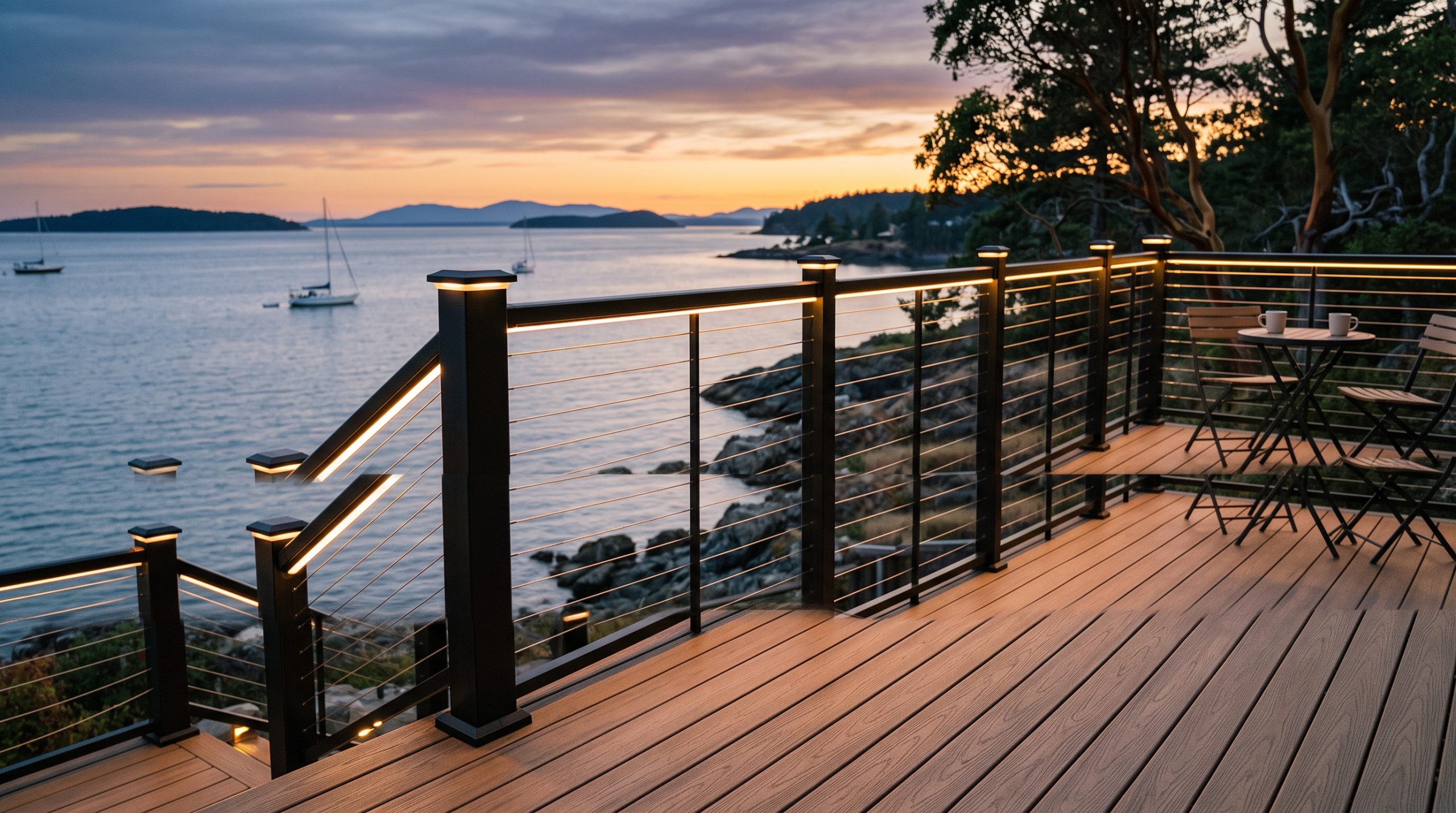
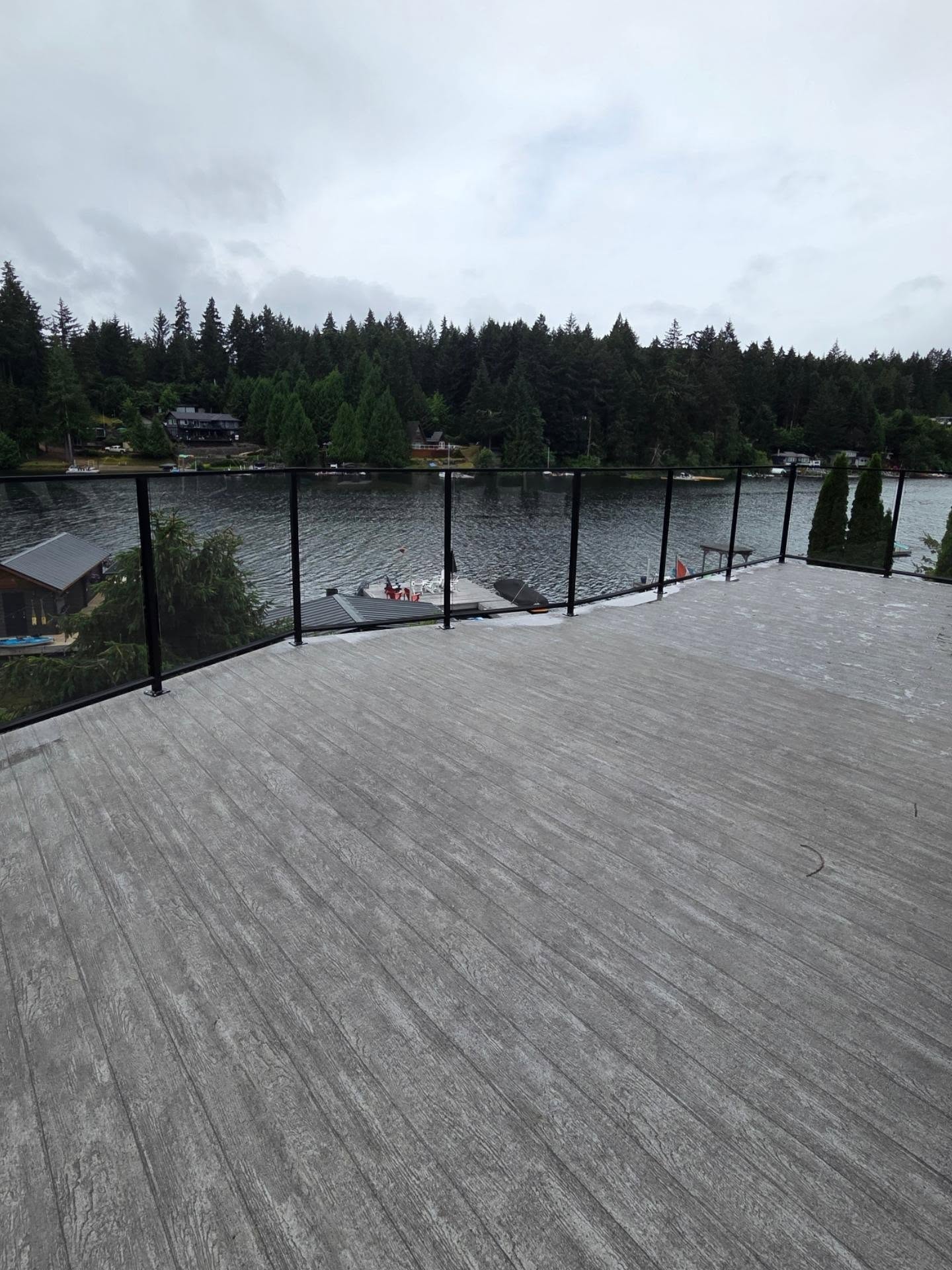
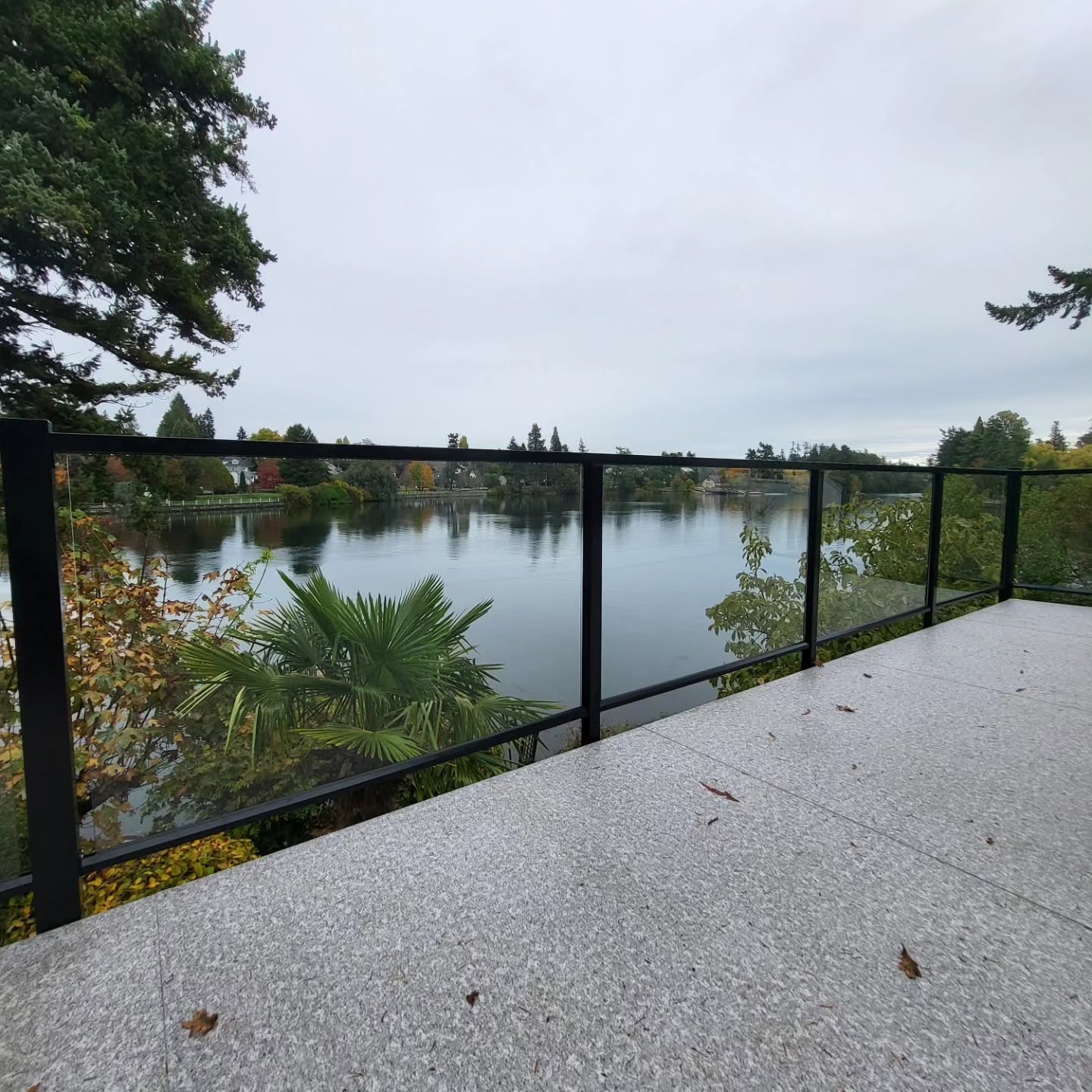
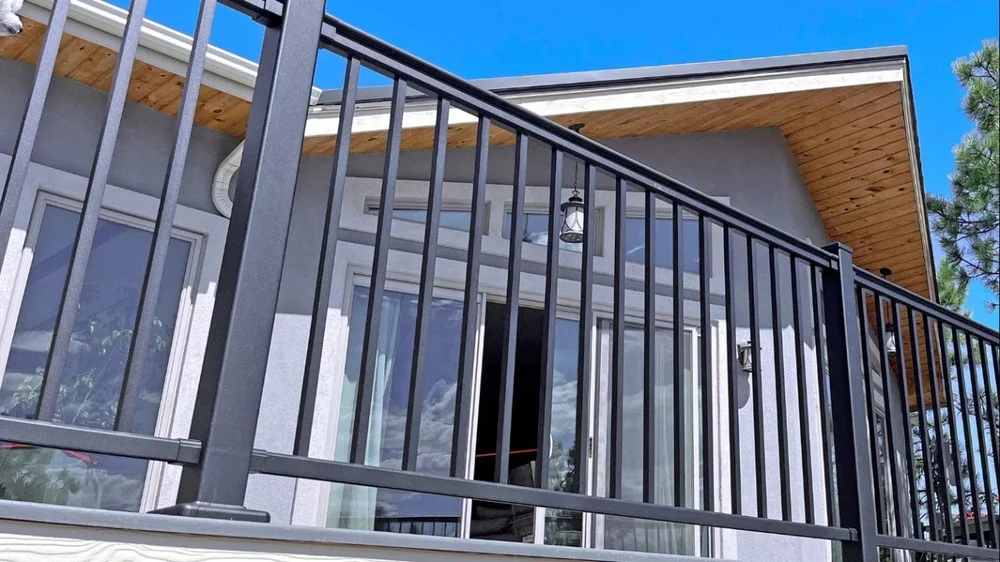
Greater Victoria homeowners know there’s something special about a sunny afternoon on the deck—whether you’re looking out at the ocean, the mountains, or the Garry Oaks in your own yard. A deck is part of the West Coast way of living: a place to unwind, host people you care about, and enjoy the outdoors.
Before you get too comfortable in that Adirondack chair, there’s one part of your outdoor space that deserves some real attention: the railing.
It’s easy to think of railings as décor—something that frames your view and ties the space together. But according to the BC Building Code (BCBC), your railing is actually a piece of structural safety equipment, formally classified as a guard.
And if you’ve ever opened the BCBC, you know it’s not exactly light reading. That’s where we come in. At Quality Aluminum Railings, we design and install every system to meet code and pass inspection, combining custom fabrication with a clear understanding of the requirements that keep your deck safe.
This guide breaks down the three key parts of the BC Building Code for deck railings—Height, Openings, and Load—and shows how premium aluminum railings offer a straightforward, reliable way to ensure your deck is both safe and compliant on Vancouver Island.
1. The Foundation: When and Why a Guardrail is Required
The very first question is simple: Do I even need a railing?
The BC Building Code answers this with a clear, measurable trigger:
You must install a guard (railing) on any walking surface where the difference in elevation between that surface and the ground or surface below is more than 600 mm (24 inches).
Think of this as the two-foot rule. If your deck, balcony, or raised patio sits higher than 600 mm (roughly two feet) above the finished grade (the ground or surface below), you are legally required to install a code-compliant guardrail. This mandate applies across Victoria, Saanich, Langford, and all municipalities that adopt the provincial BCBC.
The “why” is simple: Preventing falls. But the “when” is the critical starting point for every project. A code-compliant railing is an assurance policy for your family, your guests, and your home’s long-term value.
2. The Big Three Code Pillars: Height, Openings, and Load
When an inspector reviews your new railing in Greater Victoria, they are meticulously checking three major areas of the BC Building Code (specifically Part 9 – Housing and Small Buildings).
A. Pillar One: Guardrail Height (The Measurement That Matters)
The height of your guard is the most visible and frequently checked requirement. The Code specifies minimum heights based on the elevation difference, measured vertically from the finished deck surface to the top of the guardrail.
📐 The Two Key Height Requirements:
| Deck Elevation Difference (Measured to Grade Below) | BCBC Minimum Guardrail Height |
| Less than 1.8 metres (5ft 10in) | 900 mm (36 inches) |
| 1.8 metres (5ft 10in) or more | 1070 mm (42 inches) |
| Exterior Guards Serving Public/Common Areas | 1070 mm (42 inches) |
While the 900 mm height is technically permissible for low-level residential decks, here in Victoria, most professional builders and homeowners choose the 1070 mm (42 inch) height for all exterior railings. Why?
Future-Proofing: If you later add landscaping, infill, or a patio below, the effective drop might change, suddenly pushing your deck into the higher 1.8m category. Installing the 1070mm height from the start eliminates this risk.
Unobstructed Views: Counterintuitively, a 1070mm railing can often improve your view. When sitting, the higher rail provides a safer boundary, and a modern design (like glass or cable) makes the height disappear, framing the scenery rather than obstructing it.
Maximum Safety: Simply put, a 42-inch guardrail offers a higher level of fall protection, which is always worth the investment for peace of mind.
Local Expert Tip: Always confirm your height requirement with your contractor and, if applicable, your municipality’s permit office. The finished grade is the reference point—if your property slopes, you need to measure from the lowest point within 1.2 metres of the deck.
B. Pillar Two: The 100 mm Rule (Child Safety and Infill Gaps)
This is arguably the most crucial rule for the design of your railing infill (the material between the posts). The BCBC mandates that no opening in the guard should allow the passage of a spherical object having a diameter of 100 mm (approximately 4 inches).
This is universally known as the “100 mm Sphere Rule.”
Why the 100 mm Rule Exists:
The rule is designed to prevent a child from falling through the railing or getting their head trapped in a gap. It applies to every single opening:
-
The gap between the bottom rail and the deck surface.
-
The spacing between vertical pickets.
-
The gap between glass panels.
-
The spacing between horizontal cable runs (a crucial point we’ll cover next).
Aluminum and the 100 mm Rule:
-
Picket Railings: With pre-fabricated aluminum pickets, this is straightforward. We ensure the spacing between the pickets is always less than $100 \text{mm}$, usually around $95 \text{mm}$ or less, to maintain a safe tolerance.
-
Glass Railings: Glass is inherently compliant as it creates a continuous solid panel. The focus shifts to the small gaps around the frame and under the bottom of the panel, all of which must be sealed or spaced to meet the $100 \text{mm}$ rule.
C. Pillar Three: Load Requirements (The Structural Stress Test)
This is the hidden hero of your railing. While height and spacing are about physical barriers, load requirements are about strength. Your railing is required to withstand significant force without failing, deforming, or allowing a fall.
The BCBC specifies minimum design loads that guards must resist. For exterior guards serving residential dwelling units, you are looking at forces applied in three different ways:
1. Horizontal Load at the Top: The Lean-In Force
Your railing must resist a force applied horizontally at the top rail, like someone falling into it or leaning against it.
Requirement: Your railing system must be engineered to withstand a horizontal load of 0.5 kN/m (kilonewtons per linear metre) or a concentrated load of 1.0 kN (applied at any single point).
Translation: A 1.0kN concentrated load is roughly the force of a 225-pound person falling or hitting the rail.
2. Infill Load: The Kick-Out Force
The infill elements (pickets, glass, cables) must also be strong enough to resist pressure.
Requirement: Individual elements must resist a concentrated load of 0.5 kN applied over a maximum 300mm x 300mm area. This means your pickets won’t snap and your glass won’t shatter under localized pressure.
3. Vertical Load: The Weight Test
The top rail must also resist weight pressing down on it.
Requirement: 1.5 kN/m evenly distributed vertical load.
The Aluminum Advantage: This is where custom-fabricated, welded aluminum railings truly shine against DIY or bolt-together systems. Our systems are pre-engineered to exceed these structural loads. The strength of the welded joints and the inherent rigidity of aluminum ensures that our guards can withstand the required forces year after year, guaranteeing you pass the structural inspection without question.
3. The Modern Design Challenge: Horizontal Railings
The biggest shift in the BC Building Code in recent years relates to horizontal railing infill, specifically the ever-popular cable railings.
For many years, some municipalities prohibited horizontal elements because they could be seen as a “ladder,” potentially facilitating climbing. However, the BCBC (particularly post-2018/2020 updates) has provided clarification:
Horizontal railings are now code approved across British Columbia, including Victoria, provided they meet two crucial criteria:
They must meet the 100 mm Sphere Rule.
Climbability is only strictly restricted for guards over 4.2 metres (about 14 feet) above the ground. For standard residential decks below this height, the rules are generally relaxed, allowing horizontal infill.
⚠️ The Critical Cable Railing Caveat: Tension
While beautiful, cable railings pose a compliance challenge that DIY installers often miss: Flexibility.
Cable systems must meet the 100 mm Sphere Rule under pressure. If the cables are spaced 90mm apart but deflect (move) under a small load, allowing a 100mm sphere to pass through, they are non-compliant.
The Professional Solution:
Proper Cable Tensioning: Our professional fabrication and installation ensure the cables are tensioned correctly and secured to posts with the necessary strength (often requiring heavier-duty structural posts) to prevent any non-compliant deflection.
Engineering Data: We use components that come with engineering data proving they meet the 0.5kN infill load requirement without exceeding the 100mm tolerance.
This is why an engineered aluminum cable system is essential. You get the sleek, minimalist look you want without compromising the safety and compliance required by the BC Building Code.
4. Victoria’s Climate and Your Code Compliance
Living in the Greater Victoria area, our weather presents a unique set of challenges that directly impact the long-term compliance of your railings. The BCBC mandates initial compliance, but environmental factors dictate how long that compliance lasts.
A. The Moisture and Corrosion Factor
The damp, coastal air of Vancouver Island is aggressive. Railings must be resistant to continuous moisture and the occasional salt spray, especially for properties in Oak Bay, Sidney, and Sooke.
The Wood Problem: Wood railing systems degrade, warp, and split. This creates new, non-compliant openings as the wood shrinks or loosens connections. A railing that passes inspection one year may fail five years later due to material degradation.
The Aluminum Solution: Aluminum is naturally corrosion-resistant. When combined with a factory-applied powder coating (a process that bakes a durable finish onto the metal), it is virtually impervious to the West Coast elements. This means your railing maintains its structural integrity and its precise 1070mm height and 100mm spacing for decades, guaranteeing long-term compliance.
B. The Structural Connection: Post Attachment
The strongest railing system is only as good as its weakest connection. In Victoria, deck failures often start at the ledger board or the post attachments.
The Code Requirement: All structural connections must be designed to withstand the required loads and resist water infiltration that causes wood decay.
The Aluminum Difference: Our aluminum posts are typically secured using heavy-duty, corrosion-resistant fasteners directly to the deck framing (joists or structural beams), often requiring a custom footing or blocking to meet the concentrated 1.0kN load requirement. We install with meticulous attention to flashing and sealants to prevent moisture from compromising the structure beneath the railing, ensuring the foundation of your compliance remains sound.
5. Getting Your Permits in Greater Victoria
While here we’re focusing on the technical code, the administrative code—the permit process—is a crucial step, particularly in Victoria, Saanich, and Langford.
📜 When You Need a Building Permit for Railings:
Generally, you will need a building permit from your local municipality if:
The deck is new and its walking surface is more than 600mm above grade.
You are structurally altering an existing deck (e.g., changing the deck size or adding/moving posts).
You are replacing a railing on an existing deck that already required a guard if the replacement involves new structural connection points or alters the deck’s original design envelope.
While a simple like-for-like replacement of infill (e.g., replacing pickets with glass using the existing posts) may not always trigger a full permit, it is always best practice to consult your municipality’s building department.
The Quality Aluminum Railings Advantage: When you work with us, we ensure your project is designed, engineered, and fabricated to the BCBC standard right from the initial quote. This dramatically streamlines the permitting and inspection process, giving you the necessary paperwork and technical drawings that local building officials require for sign-off.
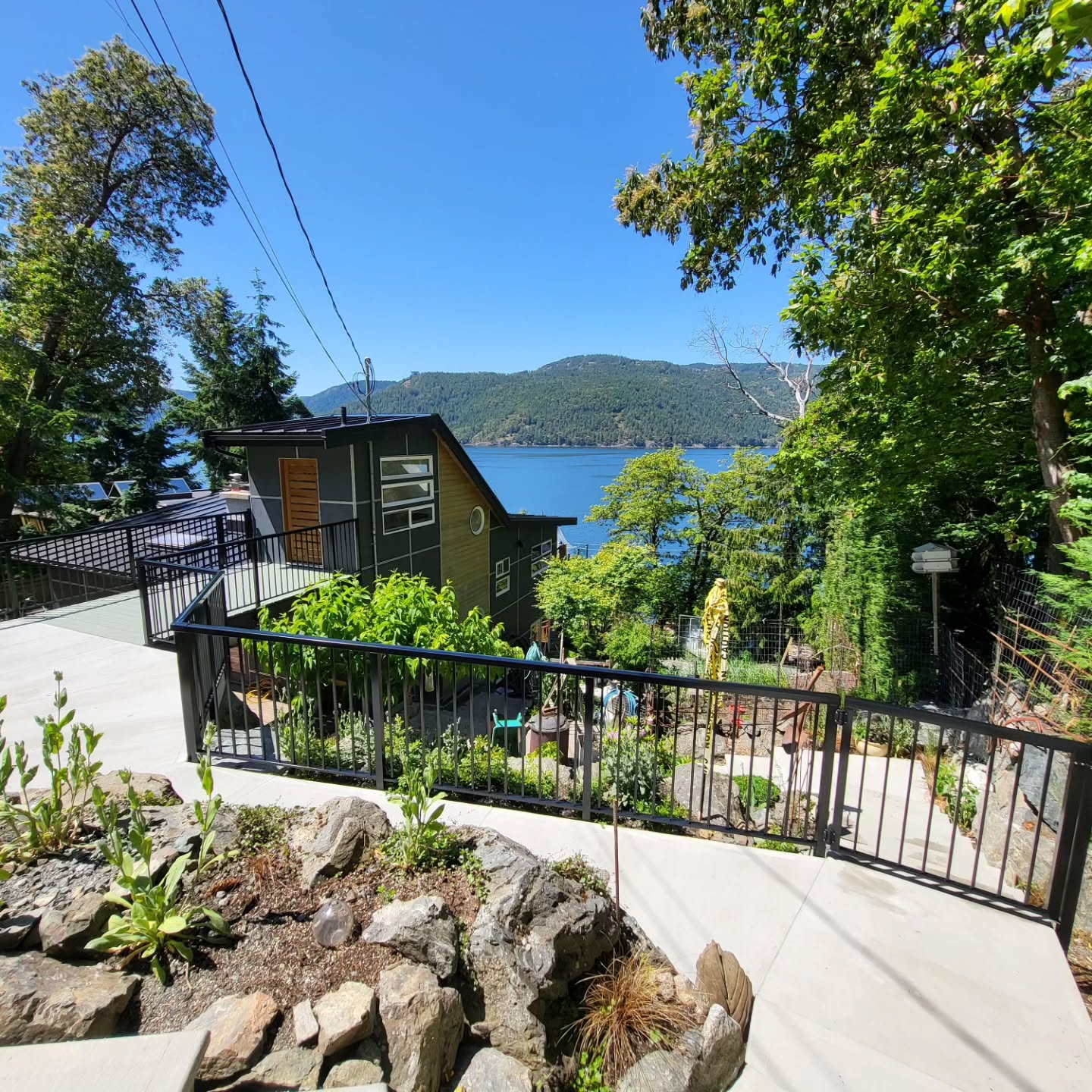
Your deck is an investment in your home and your quality of life. Understanding and adhering to the BC Building Code is not just a bureaucratic hurdle; it is the fundamental assurance that your beautiful outdoor space is safe, durable, and structurally sound for everyone who uses it.
The three essential requirements for your Victoria deck railing are:
Height: 900mm minimum, but 1070mm (42 inches) is the professional standard for most exterior decks over 1.8m high and the preferred choice for maximum safety.
Openings: The 100mm Sphere Rule must be strictly maintained across all infill and gaps to protect children.
Load: Your system must be engineered to withstand rigorous horizontal, vertical, and infill forces (like the 1.0kN concentrated load) without failure.
By choosing a custom-fabricated, powder-coated aluminum railing system—like the ones we proudly build here in Victoria—you are choosing a product that is inherently corrosion-resistant, structurally superior, and pre-engineered to exceed the strict demands of the BC Building Code.
Don’t leave the safety of your deck to chance. Choose the local experts who understand the 1070mm rule, the 100mm sphere, and the unique climate of Vancouver Island.
Ready to upgrade your deck with a code-compliant railing that’s built to last? Contact us today for a free consultation and quote. We’ll handle the complexity of the code so you can get back to enjoying that beautiful West Coast view.